


The podcasting industrial complex is like a lethal contagion, mutating into new formats to avoid our hard fought antibodies. Is Subway Takes a podcast? Is TBPN a podcast? Is the 80-minute uninterrupted conversation of Before Sunset a podcast? A podcast by any other name…
To some extent, these formats are evolving out of necessity. New shows now have to displace existing watch time. The average American adult spends 75% of their waking hours consuming some sort of media, but that number has flatlined since the spike in 2020.1 So I find it hard to believe that the next culture shifting show will be another multi-hour sitting-across-the-table interview product.2 It’s just not different enough to warrant a seismic replacement in one’s media diet. Of course there’s a path to winning with a material improvement on an old form, like Dwarkesh preparing better questions than anyone else in tech media. But I suspect we’re about to see far more shows competing with new forms entirely.
The average consumer seems to be increasingly aware of the metagame of content.3 We notice when a thing feels new. Perhaps we have been forcefed so many sausages that we feel a right to comment on how they are made. Other writers have pointed at this: Emily Sundberg on “marketinggg” and how the girlies are dissecting the machinery of branding, or Anu on TBPN and how the real “show” is watching a thing getting made. It’s another byproduct of our context collapse — the shows we watch exist side-by-side on the same infinite feeds as the paracontent about them. Of course everyone is a critic! A new format, then, is one way to avoid a knife fight against thousands of functionally identical media products.
For an artist, the format of a conversation is a large part of its message.4 Bourdain walking through the streets of Hanoi with a local resident is not the same as him sitting across that person just talking about their favourite dishes. The form in which a conversation unfolds makes a qualitative difference on the conversation itself and the way in which a conversation is received by its audience. New formats deliver on entirely different vectors of information.
Take Lil Dicky’s new show “Friends Keep Secrets,” as one example:
Lil Dicky, his wife Kristin, and Benny Blanco hang out in their actual living room, which is filled with over 18 hidden cameras
They invite over their famous friends and, instead of following a traditional interview format, just hang out as they usually would
The entire hangout is recorded and then edited down into a ~45 minute episode
It feels more similar to Seinfeld than another celebrity podcast. If podcasting was originally a chance to “be a fly on the wall while your interesting friends hang out,” then this show is literally an opportunity to be a fly on the wall while celebrities hang out. Some combination of the hidden cameras, Lil Dicky’s actual living room as the studio, and the lack of a formal interview structure adds up to something entirely novel. The episodes feel like a genuine exploration of what happens when you’re around your favourite people: impromptu jam sessions, cooking mishaps, stupid arguments.
If I was really going to stretch the word “podcast”, I’d also look at Kareem Rahma’s new version of “Keep The Meter Running.”
Kareem hails a NYC cab and asks the driver to take him along to their favourite places
They spend the day together, all while the taxi cab’s meter stays running
Each episode becomes an exploration of the working class people who keep NYC moving
It feels like half “Parts Unknown” and half “Humans of New York.” Technically, “Keep The Meter Running” was the original brainchild of Kareem and Adam Faze back in 2021, their first attempt at shortform TV on TikTok. You can imagine that they could have brought this back as another shortform vertical show, competing against the likes of Submit Your Ick or Roomies. But they’ve already objectively won that game with the nuclear success of Subway Takes. Another shortform show would be predictable, and therefore it would be artistically wack. Kareem, himself the son of a cabbie in NYC, just “wants to talk to cabbies”, and a long form show is the right way to do it justice. I respect that formats are just serving as a vehicle for his artistic message, not as an attempt to chase what the market wants.
But the market is a factor here. Designing a new format isn’t the only way to compete at the level of the metagame — once the metagame changes and a new form has emerged, commercial interests quickly follow. If artists like Lil Dicky and Kareem are leading the way on new forms of media, then the suits will always be fast followers, applying those forms to new categories.
Look at a16z-backed “Monitoring The Situation” (MTS):
They believe that the “internet is real life”
The Twitter timeline is the heartbeat of the tech industry’s internet
So it’s only natural that the Twitter timeline would have an always-on news network covering the characters and dramas that are central to it

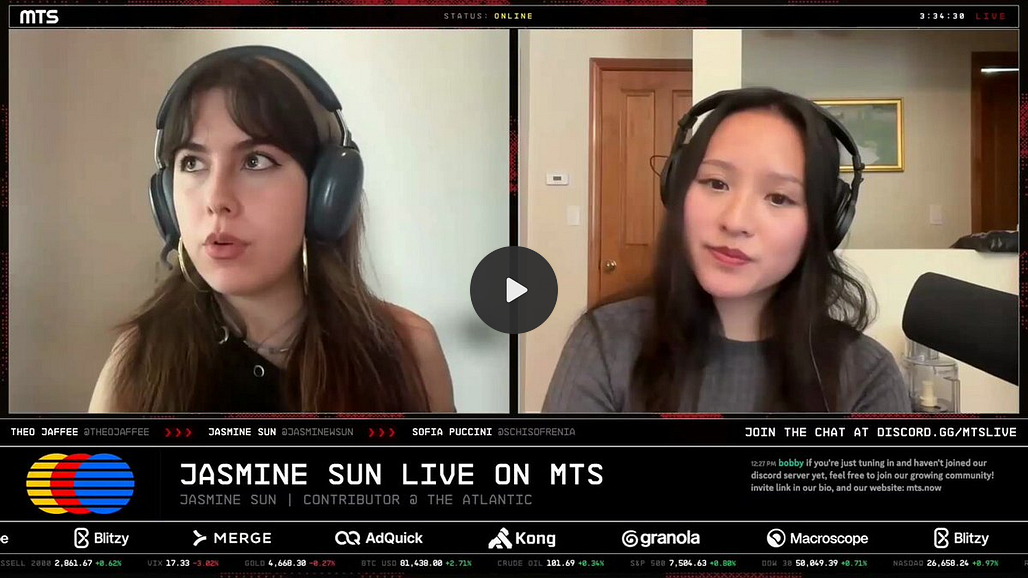

The easy critique here is to just call this Diet TBPN. MTS’s central thesis—that the Twitter timeline deserves an always-on news network—is effectively a reframe of TBPN’s thesis that the tech industry needed a “SportsCenter.” It’s wack to copy something 1:1, but MTS is the work of a suit, which is a different skillset entirely. The suit notices when a new form has pushed the metagame forward, and immediately asks “where might there be another market for this?” You see this done more tastefully elsewhere, like AvA’s new livestream show for the entertainment industry, or Breaking And Entering’s livestream show for the advertising industry.5 I respect it — different skillsets push the metagame forward in different ways.

I have an obvious bias here. I think I like “new” more than I like “better.”6 This metagame of content isn’t a new phenomenon — the artist has always pushed the form forward and the suit has always commercialized it into a new category. But the flattening of all our media into a single feed makes it more tempting than ever to just copy what works. I salute the suits who are bringing tried-and-true forms to new categories; the bag must be acquired. But we now need the artists more than ever — show us something new.
The original source has a somewhat low sample size at 4,000 survey recipients, but Doug Shapiro has some further analysis.
I’m not even sure what “culture shifting show” means anymore in our infinitely atomized culture. We’ll know it when we see it.

Shoutouts my boy McLuhan
To be clear, AvA is definitely the work of an artist, with a ~decade commenting on niche industry stories. The new livestream show feels like a different product, though.
Obligatory “The Love Song of J. Alfred Prufrock” nod. Layering in jazz rhythm and film exposition makes for something far more interesting than a poem alone!