


The internet is ass lately.
I realize that that’s likely just my own projections1 or skill issues2, but I’m obviously not the only one yearning for better digital media. I don’t have answers, but I’d like to explore this feeling for a bit.
Media companies are just art3 with a business model4. That implies a spectrum: artists on one end with pure intent to express themselves, and businesses on the other with pure intent to monetize. The media companies that I feel most strongly about bringing into the world sit somewhere in between—enough soul that their output genuinely leaves a mark on your life, but enough money flowing through that their structure is sustainable.
The media business, in almost every dimension one might evaluate it, is a bad business to be in. But I don’t mean to join the chorus of people moaning about a bygone era of media. To me it’s still the best business on the only metric that matters—it’s the lever that moves the collective unconscious. A well run media company, one that both makes good art and has a way to sustain itself, wields mind control at scale. The right sequence of words or sights or sounds is the closest thing we have to magic.
When I say “the internet is ass lately,” what I really mean is that I can’t remember the last piece of internet-native media that made an indelible mark on my life. My feeds are mostly an ouroboros of content about content, which is maybe telling on myself. I contrast that to recently discovering The Love Song Of J. Alfred Prufrock, or watching the Before trilogy, or reading East of Eden, each like a portal to a new version of myself. But wah wah wah, it’s obviously ridiculous to expect a comparable artistic experience from a YouTube video or an Instagram Reel or, unfortunately, many Substack essays. The medium is the message, and you can’t compare some of the single best artistic artifacts of all time to work that’s published at a weekly or daily cadence.
Pessimism is wack. I’m itching to see the good in all of this—to create some good from all of this. What if the unit of measurement has just changed? What if media isn’t supposed to optimize for single artifacts anymore?
I always come back to Doug Shapiro’s idea that new forms of media don’t win on old metrics of success, and instead compete on emerging definitions of quality. Early “creators” didn’t try to compete with Hollywood on the vector of production quality, and instead won on criteria like rawness and parasociality.5
I suspect one new determinant of quality is worldview itself. A body of work is how you exit the knife fight of the For You Page—the degree to which you shape your audience’s worldview over time is more important than any individual video or essay or song that you put out today. My sense is that the most meaningful contemporary media experiences will be less like a portal to a new version of ourselves, and more like a chisel that chips away at us over years.
I’ve been in a deep chakra rabbit hole recently, and without getting into too much of it here, I love the way Anodea Judith describes the sixth chakra/third eye: it’s like staining a glass window that colours light before it reaches the rest of your psyche. Maybe the best independent media companies of today—TBPN or Feed Me or Cleo Abram or Dwarkesh—function similarly. They each have standout individual pieces of work, but none that I would personally consider art in a vacuum. Their real artistic output, then, might be something like staining our metaphoric glass windows. Sundberg’s daily news roundups are well written and perceptive and surprising, but the real art is how she trains her audience’s attention to notice how culture is shaped by business. TBPN’s livestreams are absurd and creative and clearly of the culture, but their real art is framing the tech industry as something akin to a sports league. The worldview is the art.

Do I really believe that, though? I have endless respect for what TBPN or Feed Me have built, and they’ve certainly changed how I’ve looked at the world, but even in the aggregate, is that “art” to me? Maybe it doesn’t matter. Maybe defining what is and isn’t art is the boring work of long-dead critics and their long-dead profession. But there has to be some middle ground: there’s more artistic value in these worldview machines than people often give them credit for, but I can’t help but itch for bigger swings.
I recently met an incredible show producer. She describes her life’s work as “dreamcatching”; a swiss army knife that helps her friends’ moonshot ideas become real. No one can fault her if her own moonshot takes a backseat—a feature-length documentary on coffee that she has been itching to make for years. You can see her eyes light up when she speaks about it, and then flicker back to black when she admits it’d likely cost millions to produce. Fundraising conversations haven’t gone great.
I immediately think of Cleo Abram. You could imagine her producing a “Huge If True” episode about coffee, another chisel shaping the “optimistic tech” worldview of her audience. But that’s a horribly reductive version of this producer’s vision. No disrespect to Cleo’s work—an 18 minute YouTube video can teach a lot about a topic—but it’s just objectively not the same thing as a deeply researched feature film.
There has to be some middle ground here.
I think of the golden age of the Hollywood studio model, back when a homerun blockbuster would pay dividends for years: DVD sales, international licensing, TV reruns, etc. Part of the craft was reallocating resources across the portfolio of projects—predictable blockbuster hits would fund the risky art house projects or low budget romcoms. Mike Ovitz, at the peak of his CAA powers, would tell his directors that they were allowed to do one personal project for every three commercial projects.
What would that look like today?
These hyper legible worldview machines might be the reason the internet feels boring to me.6 Many people are playing for the same uninteresting prizes, while the sort of art that might genuinely change how you see the world—a “portal” to use my earlier language—is by definition going to be surprising.
But, counterintuitively, legibility might be the currency that unlocks real illegibility.
These worldview machines make money because they fit into previously understood models of reality. You sacrifice upfront at the altar of legibility so that people know how to transact with you: TBPN is ESPN for the tech industry, Feed Me explores culture through the lens of business, Cleo Abram is making optimistic tech explainers.
The trick, like the golden age of Hollywood, is to funnel that legibility into moonshot projects. The institutions who historically would have funded this sort of work have long been in freefall, but new ones will replace them. Alex Cooper funding projects through her Unwell Network. Emily Sundberg hiring J Lee to launch a food podcast. Cleo Abram, if you’re reading this, I have a fantastic documentary on coffee to pitch you.
I’m bored of the internet because of these hyper legible worldview machines. I’m excited for the future of the internet because of what these hyper legible worldview machines will unlock for us.
Points at the evergreen RFQ cultural critique tweet

Points at my 14 year addiction
Which I’d narrowly define as “pure expression that changes how someone sees the world.”
Which I’d narrowly define as “a reproducible way to make money.”
Quoting Doug’s post at length:
“My favorite example is Airbnb. Prior to Airbnb, leisure travelers’ most important attributes probably included brand reputation, loyalty program, cleanliness, daily housekeeping, security, location, on site dining options, included meals, 24-hour room service, 24-hour reception desk, on site amenities (like a pool, spa and fitness center), and maybe whether there’s a kids club or the scope of resort activities.
Airbnb introduced a bunch of new features to lodging, like a full working kitchen, a quaint or authentic neighborhood, room to entertain, a dedicated parking space, more privacy, a washer-dryer, far more closet space, etc. For many customers, Airbnb has changed their definition of quality in lodging.”
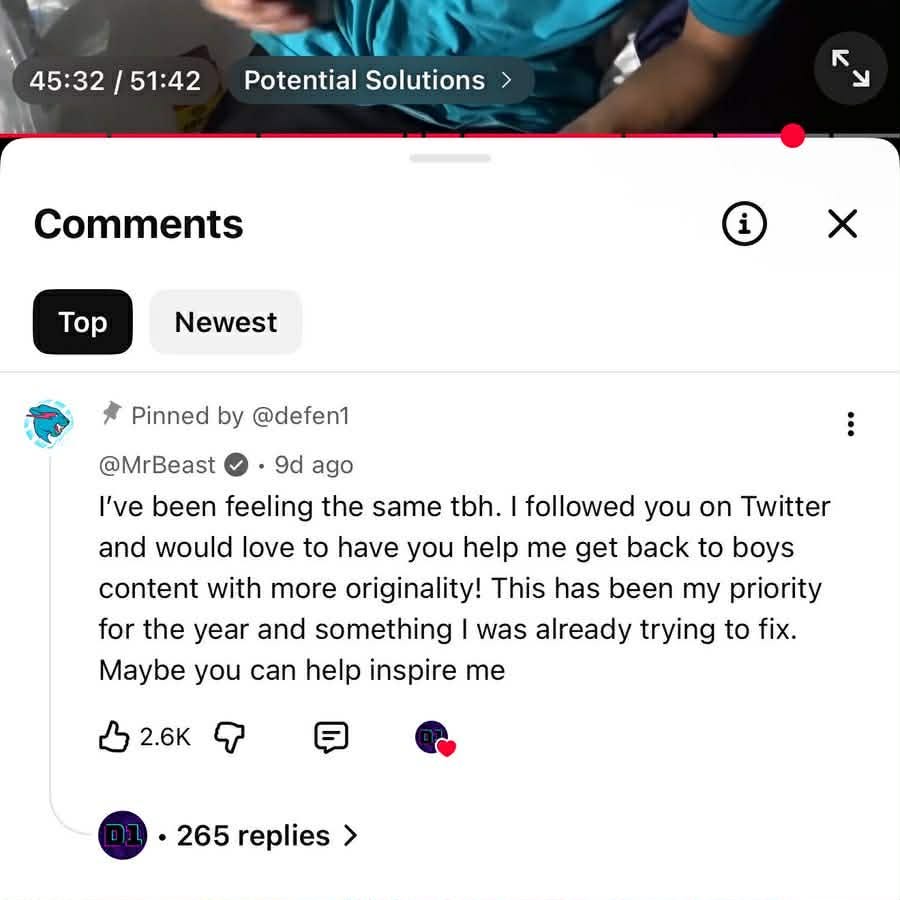
Mr. Beast’s public reply on a video titled “MrBeast is boring now”
so casual w/ that ouroboros slip-in. multi-faceted
loved this