


John Darnielle tells us to think of art like a drug — something you are putting in your body that you will test positive for later.1 We take the shape of what is consumed, and others are shaped through what we, the professional posting class, create.
It’s easy for brand posts to feel above (or, more accurately, below) this truth. There is, after all, reality to contend with: budgets and targets and view counts and all the other machinery that separates “art” from “content.” But brand content, too, ends up in the bloodstream. I suspect one reason social shows are resonating so well with people is because they do feel like art — they’re explicitly designed as a gift for someone in your corner of the internet.2
Brands are acting like people, and people are status-seeking monkeys
Humans evolved to compete for social status. Pre-agriculture status would get you access to food and opportunities to procreate, post-industrialization it gets you basically everything else.
Brands, for better or worse, are acting more and more like individual people. In the simplest sense, brands post content so that they can sell more things. But concluding that is all that they do, or saying that all of their content should be used towards those ends, is akin to saying that humans only want to procreate. The reality is that brands, especially through the lens of them individuating, use content to accrue status. One possible outcome of that is to sell more things, but today I’m more interested in exploring the process by which that status is granted.

Status in an abundant environment shifts from what you own to what you gift
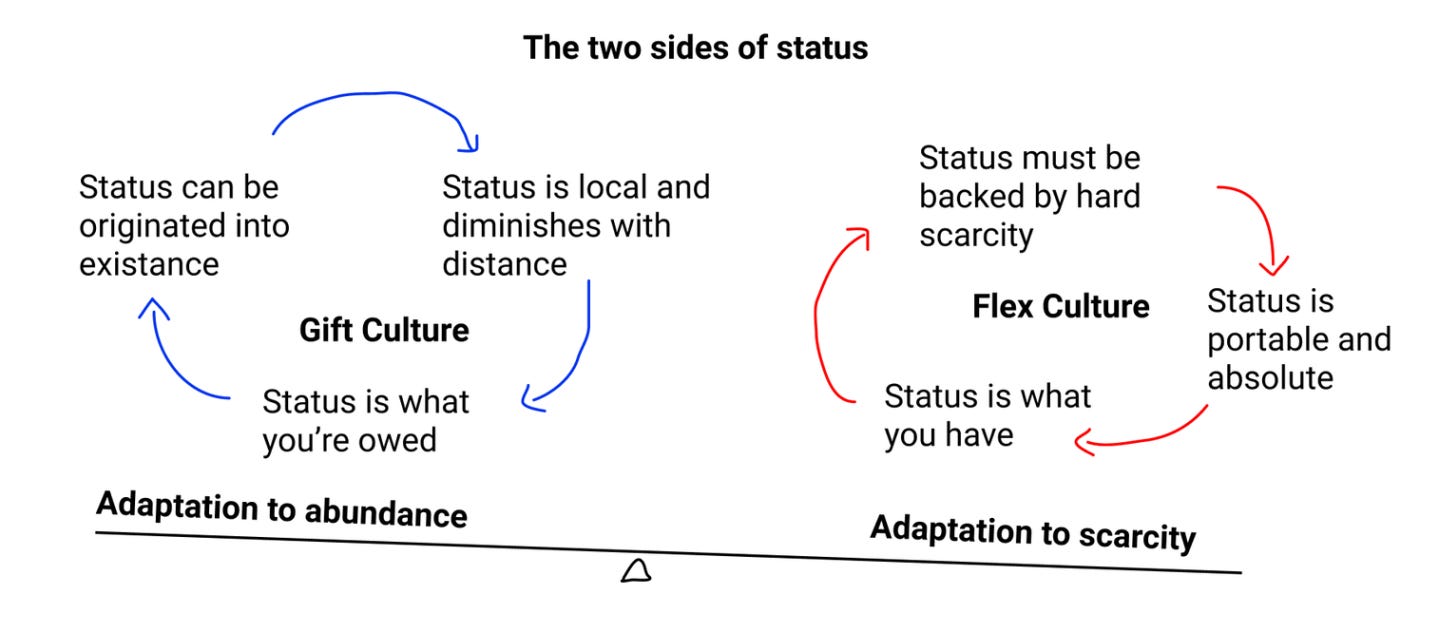
So how do these brands-become-individuals accrue status? I’m drawing on two reference texts that are worth reading in their entirety, one from Alex Danco on gift culture in Silicon Valley3 and Eric Steven Raymond on the incentive structure of open source software. They contrast scarce environments, where basics are difficult to get, with abundance environments, where the thing that used to be scarce is now cheap or infinite. In the former, it is more likely that resources are allocated (and therefore status accrued) through centralized command structures or a culture of exchanging X for Y. In the latter, however, those become unnecessary or inefficient. After all, we have far more of the thing than we can handle!
But even an abundant society is not so easily organized. Danco says, “Abundant environments may surprise you: even though they’re lacking in material scarcity or literal friction, there’s still plenty of work to do. It’s just a different kind of work: the work of dealing with complexity, clarity, curation, and especially synthesis.” In these environments, Raymond posits that “abundance makes command relationships difficult to sustain and exchange relationships an almost pointless game.” Gifting, then, becomes the mechanism to clarify and accrue status that “...is determined not by what you control but by what you give away.”
The marketplace of content in particular4, especially brand content, has long shifted from one of scarcity to one of abundance.
In relatively more scarce content environments such as 2017 era news feeds, brand content functioned more like an exchange system. They had centralized control over high production content or a monopoly on a particular product, which is becoming less and less true in a world where products are more easily commodified, in commerce and software. Here’s a rare bit of well produced content, now go buy my thing, serf.
In an abundant content environment, brands begin to give away these resources, with a less clear transaction in return. They’re launching shows without any branding or prompts to shop, but instead with the intent to build status in a corner of the internet.
Homestead a corner of the internet
In a gifting culture, status is localized. Quoting from Danco at length here:
…if you went back in time 5000 years ago and asked an early villager, “how do you solve the coincidence of wants problem?” they’d look at you strangely: “We don’t have that problem. If my neighbour has grain and I need it, I take some and then I owe him one.” That concept, “I owe him one”, is really powerful. In this paradigm, money is fundamentally an IOU. It is not a representation of hard scarcity; it is a representation of trust between two people. Money, just like trust, can be originated or destroyed. It is local, and contextual. It’s made of reputation.
…
You may be wondering where is all leading up to, and it’s to make this point: status is like money.
There are versions of portable status, like real-life fame or being 6’2, but these are more shallow indicators of community standing because of their portability. Generally, the ways in which one demonstrates status in the open source software community are not the same ways one demonstrates status in the angel investing community, which are not the same ways one demonstrates status in a particular brand’s community.
The key, then, is that your gifts have to be designed for a particular corner of the internet. Abstract away from your product, and think about its philosophy or broader mission: Roomies, rent-to-reward company Bilt’s social show, is not about points software, it’s about coming-of-age as a young city dweller. It’s an attempt to fertilize a very particular plot of land for a very particular person, without asking anything in return.
Designing a good gift
In the context of social shows, a good gift would:
Be a story worth watching on its own accord
This is arguably the most important of a gift. It doesn’t ask for anything in return! It’s not an ad disguised with high-production quality. Think: Olivia Unplugged or Bittarverse.
Create new culture, not just remix or extend existing references or worlds
Flipping a trend for your own niche is fun and useful. But taking a risk on the creation of new culture, whether in literal production dollars or just creative risk, is a real gift. Think: Brita or Duolingo’s Anime.
An opportunity to look in the mirror or pay the gift forward
“Shares” strongly determine whether the algorithm will spread a video or not. People share things for two reasons: to represent something about themselves, or to encode a message to someone else. A good gift in this context, then, is like a base layer, something that the recipient can riff on. I wonder what percentage of Instagram Reels are DM’d with the caption “me,” or “us,” or “you.” Spotify Wrapped is perhaps the canonical modern example of “gift as mirror,” while a social show like Brooklyn Coffee Shop is a good example of “a gift that can be gifted forward to a particular person.”


Gifts, Danco says, are in some ways just a channel for information sharing. “The giver can assign all sorts of meaning to a gift about its purpose, how it was made, and what they love about it, and the recipient will actually receive that message.”
Through this lens, some of the emergent behaviours across different social networks start to make more sense. Twitter’s quote-retweet dunk culture feels like a gift to your in-group, almost literally “serving a head on a platter.” Or, even as Instagram copies everything else about Tiktok, gifts might explain why they still feel like two distinct cultures — the latter rooted in its remix culture of gifting absurdity and in-jokes to one another, while the former is still trying to shed its past of influencers stunting on your scarcity.
This was not meant to be a tactical post. I’ve been in the content mines for a month now, digital coal smeared on my face as I churn out 3,000 or so words a week, and I’m relishing the opportunity to really be in it after having spent so long quarterbacking media strategies from afar. But it’s refreshing to take a step back from the how to focus on the why. I often say that “businesses should act more like creators,” and this is a perfect example of that: you can sense when a creator is in it for the love of the game, versus just chasing some viral moment. The same is true for brands. Homestead your corner of the internet with genuine gifts, and the status you accrue will pay off in time.
I actually can’t find the original quote attribution but the Princess of the Internet RFQ cites it, so it must be real.
Any episodic content with a familiar through line, such as a recurring concept, theme, or set of characters.
Brands have long, of course, literally gifted products away.
This is fantastic dude. As a brand owner who is very dumb when it comes to culture and content, your writing really helps define the stuff that we can all see but are not as adept at defining and clearly conceptualizing as someone like you. Please keep on teaching us!