


Game Tape is a weekly series where I highlight lessons from a new media property. Today we’re talking about entry points to your core franchise and channel-native formats.

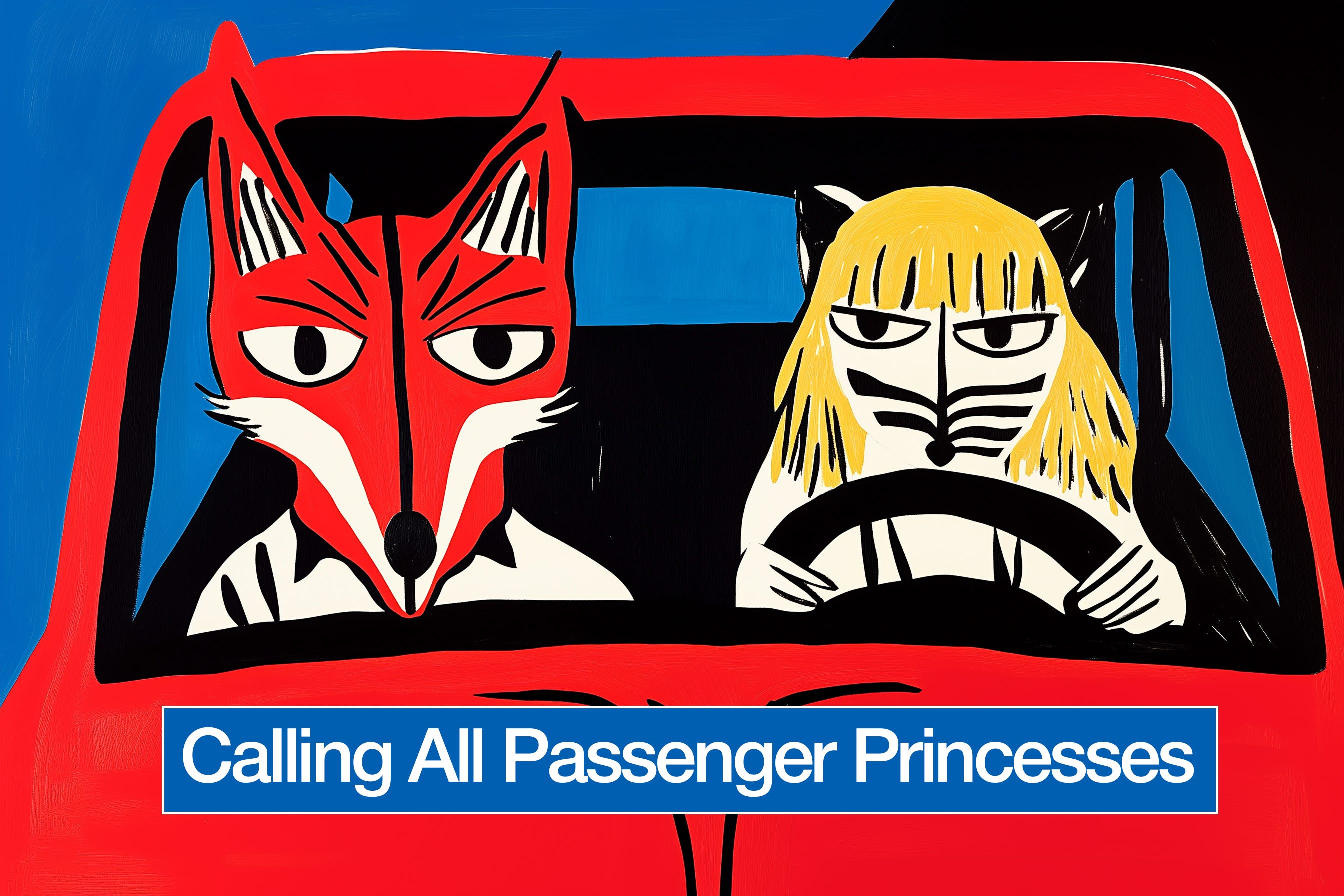
" “I don’t drive. I was too poor. And then I was too rich.” - Alex Karp” " - Amelia Dimoldenberg, presumably, as she learned to drive on the set of Passenger Princess.
F1 used to be for nerds, and then the hot people arrived.
Back in 2003, my brother and I used to have sleepovers with a family friend who lived down the street from us, but while we were gloriously sleeping in on Saturdays, content to enjoy a rare morning with neither Normal School nor Islamic School, he would be up at the crack of dawn to watch cars drive in circles (and other circle-adjacent shapes). It made no sense to me then, and admittedly, it still makes very little sense to me now, even after Drive to Survive took the world by storm to inspire a new generation of casual fans.
It’s incredibly baller that F1 was able to create a new entry point for casual fans into what has historically been such a monocultural sport. So when they run the same strategy via a new YouTube show with Amelia Dimoldenberg of Chicken Shop Date fame, you’ve got to pay attention.
The gist of the show is:
Amelia doesn’t know how to drive, so she enlists four F1 drivers to teach her.
Each driver is responsible for a specific lesson, such as “Parallel Parking” or “Reversing.”
Amelia interviews each driver with her trademark dry humour as she fails each test horribly.
A few takeaways:
I. Create a new entry point to your core franchise
A media empire needs to have IP that exists beyond its core franchise. Disney is not Disney if Mickey Mouse is all it is; Cinderella and Moana and Woody are all entry points that exist independently of the core brand, but benefit from their association with the central media infrastructure. New IP is a gateway drug to pull you into a broader universe.
F1’s media empire is less diffuse than Disney’s, since every one of its media properties still revolves around the sport: Drive to Survive, the F1 movie, and their podcast. But each property still serves as a unique entry point or touchpoint for a different type of customer. Women now account for 3 in 4 new F1 fans, and Passenger Princess is purpose-built for them:
The show’s name is a TikTok joke for women who prefer to passively hang out in the passenger seat.1 But it’s fascinating how the intersection of “being a passenger princess” and “learning how to drive” gets fans to project their own driving associations onto these episodes. Just scroll through the comments, “PTSD to my dad yelling BRAKE BRAKE BRAKE”, or “Ollie is the younger brother, Carlos is the father”, etc. The magic of the show is that it takes what used to be known as an “old, rich, white man sport” and presents it in a context that feels familiar to a new audience.


II. Build for the channel you’re on
The easiest way for a brand to crack YouTube is alongside a creator who has already cracked YouTube. Passenger Princess was owned from soup to nuts by Amelia’s production company, and it’s clear they understand how to build a show that truly feels native to the channel:
Concept testing
Chicken Shop Date is the perfect environment to test which characters and angles are resonating with her audience. So when she interviewed F1 driver Lando Norris and saw an onslaught of comments from her audience wanting more, it immediately made sense to pitch a broader partnership with F1.
Historically, pilot episodes were an attempt to test audience interest around a show concept. But it’s now far easier to get contact with reality and test an angle when you already have several million people listening to your podcast or other digitally native media property. How can you use your existing channels to your audience to test new concepts without actually getting on set?
Packaging
Packaging is half the battle on YouTube, and it can immediately indicate the difference between brands that understand the platform and those that don’t. Don’t take it from me, take it from Airrack, who runs one of the fastest growing channels ever: “The first 30 seconds of a video are everything. I’m telling you. Some really smart YouTube people are meeting in a room every month, and the only conclusion they come to is that the title and the intro are more important than they thought they were last month.”
Oatly, for example, launched a show last year that seems to have totally flopped, with ~2,000 cumulative views across 10 episodes. Look at their thumbnail and titles:
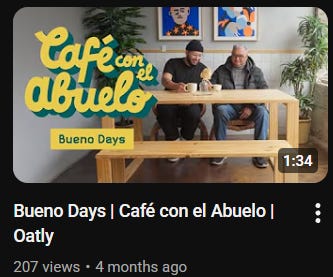
What is this show about?!?! I loosely understand that the concept has something to do with a cafe and a Grandpa, but it’s certainly not clear on a passive scroll (we speak French in Canada, not Spanish.) There’s no tease of a story in the thumbnail, the title just rehashes the branding and doesn’t give any additional context, and I have no reason to click this in a sea of YouTube content. If I did happen to click the video, I would bounce away immediately while they spoon-feed context with an intro monologue instead of dropping me straight into the action with a hook or cold intro.
Compare this to Passenger Princess:
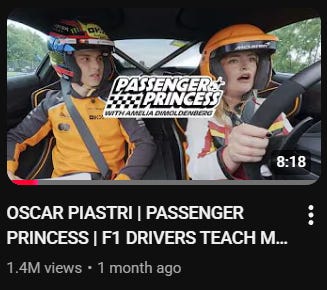
It helps that Amelia is one of the most recognizable faces on YouTube, but even if you don’t know the characters, you understand the concept in a millisecond: The “Passenger Princess” name itself is clear and evocative of a widely recognized internet joke, someone is driving, and it seems like something interesting is about to happen (look at her face). The title of the video is another layer of context, and includes both “F1” and “Oscar Piastri” to maximize its surface area with new audiences. As soon as you click into a video, the first three seconds are a cold open that gets straight into the action, and then they back into some more context for the viewer.
I am neither an F1 fan nor a close follower of Amelia’s, so this show was obviously not designed with me in mind. I loved the concept, and I think it’s a great template for future F1 expansion products, but I just don’t think it’s that great as an entertainment product. The episodes have some funny moments, and Amelia’s dry humour really shines when she’s under pressure, but 8-minute episodes aren’t enough time for in-depth conversations, nor are they enough time for real high-action episodes. So we’re left with neither. To be fair, she had only 2 hours to film all 4 episodes, so it’s an incredible feat of showmanship that she was able to pull this off at all. But seeing as each episode has cleared a million views already, I suspect there’s more to come from this partnership.2
Things I’m learning from this week:
Investing and the Media Business by Will Manidis. I’d eventually like to write about tech’s “New Media” hard-on, but I keep getting distracted by all the other good takes.
Your Phone Isn’t a Drug. It’s a Portal to the Otherworld. Katherine Dee, “Default Friend,” is doing some of my favourite writing on internet culture.
Los, the world’s first appstar, is making you the main character of the Timothee Chalamet stunt. “Software at the speed of culture” is a cool evolution of the form.
Not to be confused with a “Pillow Princess.”
I’d love to see her add some more stakes and structure to the show, similar to other challenge series like Speed Goes Pro or MK Ultra. Each episode could be something like: Amelia gets a lesson from an F1 driver, she practices herself, and then has to complete some sort of challenge to cap it off, like completing the test side-by-side with a driver’s ed student to see who’s better.